
Death of the Triple Bottom Line
Almost 30 years ago, John Elkington introduced the concept of the Triple Bottom Line. People, Planet, Profit: a structure for evaluating a company’s performance with the intended purpose of driving positive change along all three axes. 25 years later, he demanded a recall.
It turns out, a framework alone couldn’t transform business decision-making.
“Whereas CEOs, CFOs, and other corporate leaders move heaven and earth to ensure that they hit their profit targets, the same is very rarely true of their people and planet targets. Clearly, the Triple Bottom Line has failed to bury the single bottom line paradigm.”
The ultimate problem came down to this: intention and incentive didn’t align.
To understand why, let’s talk about business decision-making in shareholder value capitalism. In this type of economy, company leadership is legally obligated by fiduciary duty to serve the interests of the corporation and shareholders, an entrenched dynamic that (by and large) incentivizes short-term Profit. This feels like present bias: the tendency to value smaller, more immediate rewards over a larger payout later on. Meanwhile, People and Planet initiatives cost organizations money in the short term; they involve complex accounting, and reports on hard-to-measure impacts for the long-term promise of ‘brand value’ and ‘risk avoidance’. In a contest between Profit or People and Planet, it should come as no surprise that Profit wins.
Despite best intentions, the Triple Bottom Line did not radically reform business dynamics. Awareness proved insufficient to drive action, a lesson emerging initiatives should take to heart.
So how can we align business interests with social and planetary progress?
In this piece, we lay out a vision for a future where business and biodiversity preservation go hand-in-hand. We believe that if Planet-positive outcomes, like biodiversity preservation, become a by-product of doing business, or better yet, a catalyst for it, service to the greater good stops looking prescriptive and becomes inevitable.
The Business of Biodiversity
Biodiversity represents the variety of living things within a particular ecosystem. Earth’s ecosystems are naturally biodiverse, filled with a mixture of species that serve complex, interacting functions and support the survival and resilience of the whole.
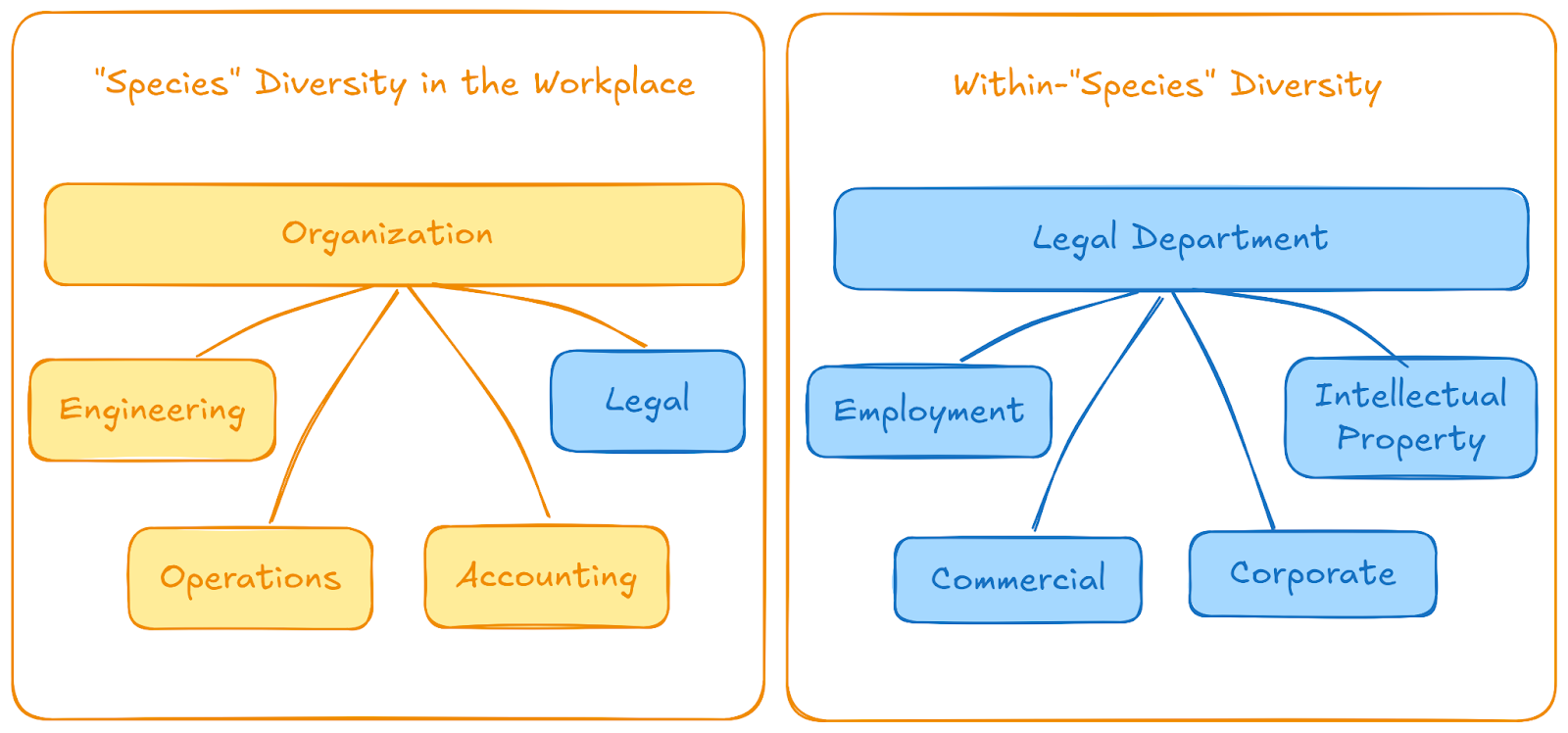
To use a corporate analogy, you’ll find a number of “species” within any organization: engineers, operators, accountants, and legal experts. Each of these species plays a critical role in ensuring the overall performance of the system. But biodiversity is more than the number of species in any one setting. Variety at the subspecies level is an essential driver of success. In your legal department, for example, it’s critical that you have different kinds of lawyers on hand – some to negotiate your sales contracts and others to manage your intellectual property portfolio.
More people and more organizations are focused on biodiversity than ever before. Global accountability is rising. A record 125 countries submitted national biodiversity reports to the Convention on Biological Diversity for review. On January 1, 2026, a new biodiversity standard (GR101) came into effect, compelling companies to disclose biodiversity impacts across their value chains. $22.4 trillion in assets are committed to nature reporting. Biodiversity and natural capital credits are projected to reach $48.7 billion by 2034. We’ve even seen the rise of the first biodiversity-focused venture capitalists.
These initiatives couldn’t come at a more important time. Wildlife populations have declined 73% in the last 50 years. Over 1 million species are threatened with extinction. Change is necessary. Fortunately, awareness is growing. But, preserving biodiversity still costs money. On paper, a biodiversity investment has the returns profile of a donation. How can we avoid the same pitfalls as the People and Planet initiatives that came before?
More than an offset, biodiversity has to be positioned as an asset.
The World’s Most Productive Manufacturing Platform
If we want to talk about the business of biodiversity, we should start with the world’s most important manufacturing platform. One that’s been around for about 500 million years: plants.
Plants run our economy. They underpin half of global GDP, and plant-based industries employ more people than any other worldwide.
Plants are our most prolific producers. Plants represent 80% of the world’s biological mass. From our forests alone, we harvest 4 billion cubic meters of wood each year. Put into context, if we loaded that wood into semi-trucks laid end to end, the traffic jam would circumnavigate the globe nearly 18 times.
Plants are also our most prolific inventors. Versatile and ubiquitous, they generate foods, vitamins, materials, medicines, fuels, and fibers – countless outputs with wide-ranging applications. Over 60% of current anticancer drugs originate from natural sources. More than 40,000 plants serve well documented uses in daily life.
Plants are so capable and agile because of their diversity. Encoded into the DNA of every plant are the production instructions for a wide variety of materials, medicines, foods. DNA is the blueprint. Every individual’s DNA is different, holding specialized instructions that determine what, where, when, and how they grow.
In a single patch of forest grown from thousands of seeds, each tree has unique quirks and capabilities. Some trees will grow a lot of wood, others will grow stronger wood, some will survive better during droughts or disease, and others will produce high quantities of valuable medicines. Each of these superpowers is valuable in response to specific needs.
For industry, biodiversity is a library of production blueprints, encoding the manufacturing instructions to create the compounds, materials, and structures that people depend on. The larger the library, the greater the productive range. Today, so much of that productive range remains untapped. Although the volume of our plant consumption is huge, our palette is surprisingly narrow. 66% of crop production comes from just 9 species. What about the hundreds of thousands of species that remain the enigmatic keepers of future cures, future foods, and future materials?
A biodiverse ecosystem is a rich, green frontier.
DNA: The Currency of the Bioeconomy
Biodiversity is so much more than an ecological asset, it’s a capital one. Unique genetic codes have taken millions of years to accrue, and are held in trust by living organisms. If plant ecosystems are our living bio-banks, DNA is the currency.
The trouble is, we’re running down our bank balance. 40% of plant species are on the verge of extinction. Today, many plant industries are use-it-and-lose-it operations. Harvesting a product often means destroying the production blueprint that created it. The result: short-term product access traded for long-term productivity. A near-term trade-off of Profit over Planet.
Many forests bear the scars of this reality. High-grading is the practice of cutting the best and leaving the rest. Say you’re looking to harvest a big heap of wood to build yourself a house. From an efficiency perspective, it stands to reason that you should cut down the biggest, and straightest trees to get more quality wood per tree you cut. But what’s left behind? All the small, crooked trees that you didn’t want. Now the production blueprints that yielded your quality product are gone, and that DNA will no longer be passed on to future generations in the landscape. That means quality wood will be harder and harder to find for every future house you need to build.
This challenge is not unique to forestry; it’s encountered across plant industries. Today our bio-bank is like a checking account, and to access quality physical goods, we have to spend down DNA. But what if biodiversity assets could behave less like a checking account and more like an endowment fund? We could maintain the principal and benefit from it too. An endowment fund is built on a principal capital investment that remains untouched. The initial contribution generates investment income, providing a steady stream of operating funds for its stewards.
A biodiverse ecosystem, left to grow, will naturally accrue genetic value over time. New combinations will arise as plant populations are permitted to mature, reproduce, and expand. Every ecosystem is a living R&D lab. All we have to do is permit them to experiment. So far, this mandate has been at odds with the market’s drive to supply the products that serve human needs. Business and planetary ideals are often in tension, and serving one usually necessitates depleting the other.
To make biodiversity mirror the perpetual growth profile of an endowment fund would require a totally new mechanism for production; one that allows us to access the products we need without sacrificing the plants that create them. We’re halfway there. We have a valuable DNA collection in the bio-bank. Now, all we need is a mechanism to create value from that asset without drawing down the principal. Then, at last, we’d have the tools to align the vector of business with that of biodiversity.
Paying Dividends with Biomanufacturing
The endowment fund model for biodiversity only works if you can separate plant production from the plant itself, so you can have your plants and your plant products, too. That’s where biomanufacturing comes in.
Plant biomanufacturing uses cells to directly generate plant molecules, materials, or even Fabricated Seeds, without ever growing or harvesting a whole plant. A biomanufacturing process can take many forms, and we deal with many weird and wonderful variants at Foray. A common version of this process typically involves: (1) the discovery or engineering of a cell line that produces the desired product at the necessary levels, (2) incremental scale-up, and (3) downstream processing to refine the target product for customers.
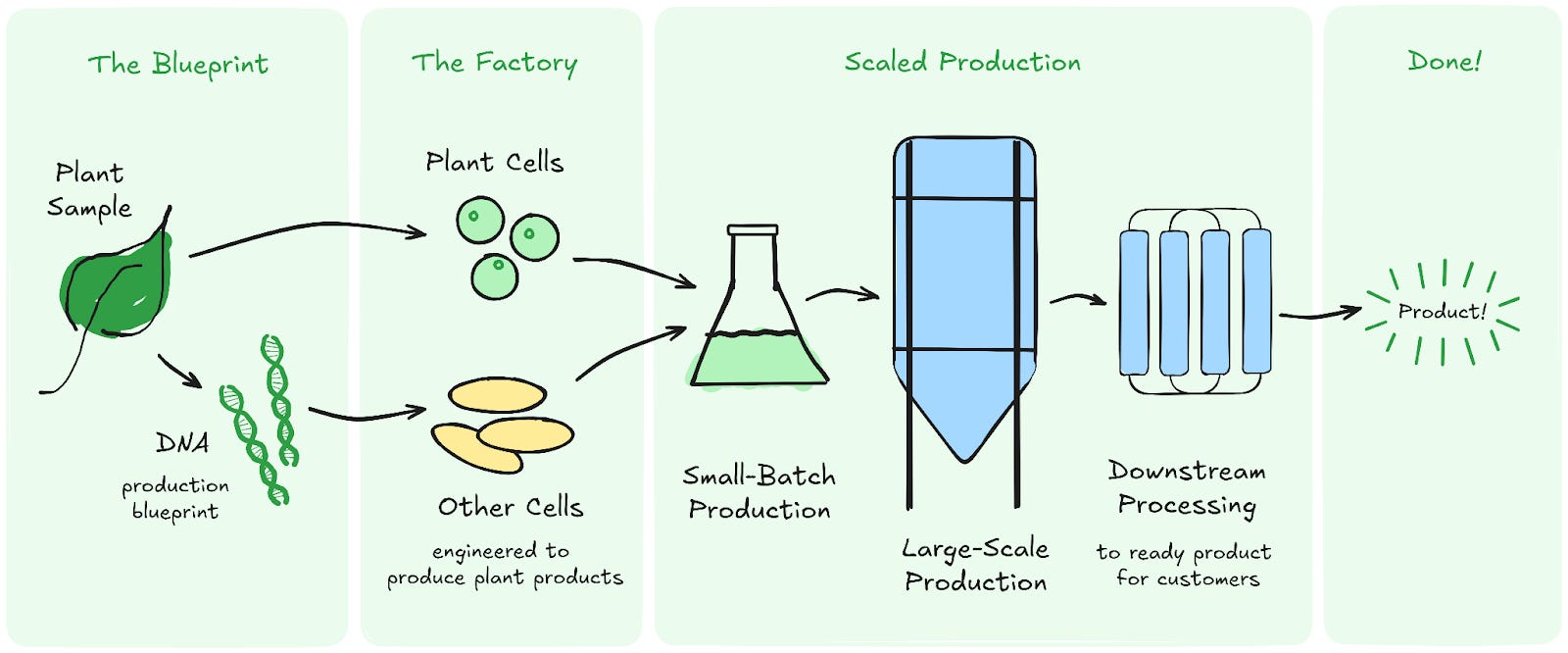
Biomanufacturing typically evokes giant stainless steel fermenters full of microbes, but it can also involve plant-less roots generating chemotherapies, plant embryos sprouting from mats of cells, and cells in bio-printed scaffolds maturing into plant materials.


Aside: Biomanufacturing is powerful, but like any manufacturing process, it involves tradeoffs. And for every product, we should consider product-technology fit, inputs, scale, and net impact. Biomanufacturing will not replace all land cultivation, nor should it. Plants are good at what they do, but for many species, global consumption outpaces natural production, risking the permanent loss of many species.
For the first time, biomanufacturing offers an opportunity to decouple production from the organism. In other words, we can leverage DNA without draining the bank. The first step in unlocking the industrial value of biodiversity is understanding its potential. Fortunately, the business of DNA is not new. In recent years, a growing number of companies have emerged to gather and screen wild organisms, accelerating the process of identifying industrially useful genetic instructions. Unfortunately, discovery is not the product. Access to the right DNA is essential, but insufficient. The genome offers instructions for production, but it still needs a factory. Nature’s factory is the plant, but with biomanufacturing, we don’t need a whole plant to deploy the DNA blueprint; we just need the right cell. Under the right conditions, plant cells can grow, endlessly multiply, and even change physical states, all without ever existing as a whole plant. The cell is the most foundational biological unit, and a microscopic manufacturing platform that makes harvest-free production possible.
In this new future, DNA becomes the currency of the bioeconomy, and the custodians of biodiversity control a wealth of production possibilities. But, without biomanufacturing, that wealth remains locked away. It’s the builders of biomanufacturing solutions, those who have unlocked the secrets of the cell, who enable that bio-bank to pay dividends.
The Future is Green
For too many years, we’ve accepted nature loss as a cost of doing business. That thinking has caught up with us. Over 30 years ago, the introduction of the Triple Bottom Line marked a concerted shift in intention – a desire to make doing business good for people and the planet as well as the bottom line. The Triple Bottom Line provided an important framework for understanding and monitoring business impact, but, by and large, the underlying movement failed to achieve its mission. Awareness wasn’t enough to drive change. Incentives didn’t line up.
Today, nature is arguably the world’s most undervalued asset.
Biomanufacturing represents a categorical break from the logic that use must imply depletion. By decoupling the product from the plant, we can move to a model of perpetual growth. Biodiversity starts to behave like an endowment fund. We have a natural asset: a vast collection of DNA, the production codes for an assortment of foods, medicines, materials, waiting to be unlocked. And now, with the increasing capabilities of biomanufacturing, we have a mechanism to operationalize that asset without drawing down the account.
When biodiversity becomes an asset, the tradeoff between Planet and Profit disappears. Biodiversity becomes a business catalyst, and an active participant in the invention of new technologies. Biological principal and economic returns can exist simultaneously and create compounding value when they do. The businesses that successfully align economics and the environment will be the durable pillars of industry for decades to come.
The Triple Bottom Line was a necessary first step to bring awareness. Today, we have the manufacturing tools to turn that awareness into action. We no longer have to choose between our products and our planet; we just have to decide how to manage the most valuable endowment fund on Earth.